ESP32-C6 Boards
There are several boards available using the ESP32-C6 chip.
The ESP32-C6 variant of the ESP32 is supported by the espressif ESP32 Board package and by the Homeding library.
The ESP32-C6 is based on the ??? processor that operates at up to 240 MHz.
It offers:
- Wi-Fi (2.4 GHz, single band)
- Bluetooth 5, LE and Mesh
- CPU clock speed up to 240 MHz
- Max 45 configurable GPIOs
- 512 KB static RAM
- 16 KB of static RTC RAM that keeps data as long as powered.
- 4 KBit of eFuse memory for special data like encryption keys
- 384 KB of ROM
- integrated Touch sensors
- SD/MMC interface
- Camera interface
- Various Display interfaces
- USB and USB OTG interface
- 2 * I2C Interface
- 4 * SPI Interface
- 2 * I2S Interface
- JTAG interface
- PWM for LEDs
- low-power-mode
- crypro acceleration
- Secure Boot
- Flash encryption
- Direct USB support.
- integrated Flash Memory (option)
- integrated PSRAM Memory (option)
This SoC is positioned as a high-power SoC MCU with Wi-Fi and Bluetooth 5 (LE) for general purpose devices. The built-in LCD interface allows fast display performance.
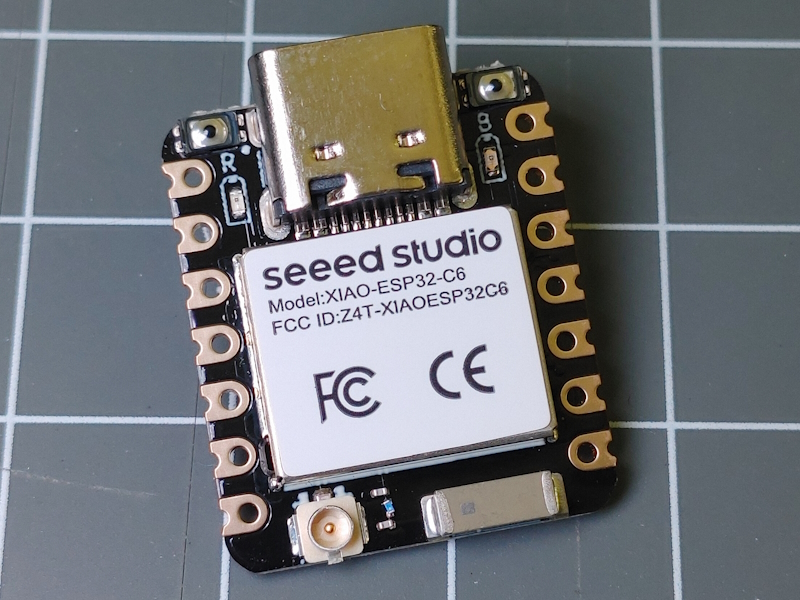
It is part of some modules that offer PCB antenna or antenna connectors.
The official Arduino Nano ESP32 is based on this processor using a custom Module from U-BLOX.
Flash and PSRAM Memory options
Some versions of the chip offer an internal 4 MByte Flash ROM and/or internal PSRAM.
USB and JTAG Support
The ESP32-C6 SoC directly supports USB and USB OTG ports and also has a built-in JTAG adapter for debugging. Some boards still come with a USB to Serial chip.
Using a board with a USB to Serial chip
When you find a USB to Serial converter on the board the configuration for the USB features in the ESP32-C6 SoC must look like:
- USB Mode: Hardware CDC amd JTAG
- USB CDC On Boot: Disabled
- USB Firmware MSC on Boot: Disabled
- USB DFU on Boot: Disabled
- Upload Mode: UART0 / Hardware CDC
Using a board with direct USB connectivity (CDC mode)
These boards offer a USB connector that is connected to the GPIO19 (D-) and GPIO20 (D+). The configuration for the USB features in the ESP32-C6 SoC must look like:
- USB Mode: Hardware CDC amd JTAG
- USB CDC On Boot: Enabled
- USB Firmware MSC on Boot: Disabled
- USB DFU on Boot: Disabled
- Upload Mode: UART0 / Hardware CDC
When you find a USB to Serial converter on the board the configuration for the USB features in the ESP32-C6 SoC must look like:
To use the USB port as Serial port the CDC on boot option must be enabled in the Arduino configuration.
Bluetooth LE
The ESP32-C6 supports Bluetooth LE , Bluetooth 5 and Bluetooth mesh.
Bluetooth support is not yet given by the HomeDing library.
Powersave modes
several sleep modes:
- Modem-sleep mode
- Light-sleep mode
- Deep-sleep mode
Watchdog timer
Cryptographic Hardware Accelerators
Secure communication, signing packages and flash memory is supported by some built-in special functionality.
This results in faster secure (https) network requests.
Boards with ESP32-C6
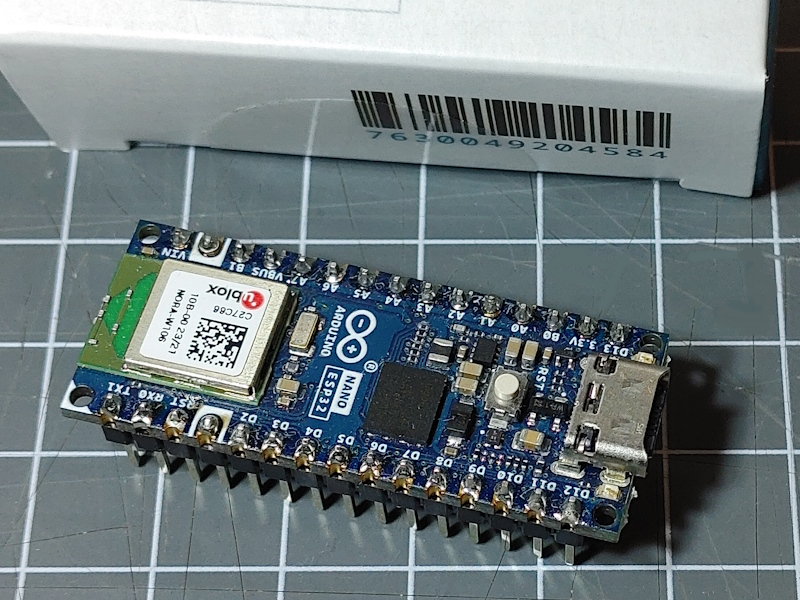
Arduino Nano ESP32
This board is an official Arduino board with the ESP32-S3 chip
See also
- Product web site: https://www.espressif.com/en/products/socs/esp32-C6
- ESP32-C6 datasheet https://www.espressif.com/sites/default/files/documentation/esp32-C6_datasheet_en.pdf
- Arduino Nano ESP32
- ESP32-C3 boards
- https://www.youtube.com/watch?v=hJSBTFsOnoA